As I have been asked to keynote some conferences on social media in healthcare I have found it necessary, or at least desirable, to take a broader view of the topic instead of just describing our Mayo Clinic experience.
Don’t get me wrong: I actually think our Mayo Clinic experience in social media, and the story behind it, is probably the most important contribution I can make to the discussion. After all, philosophy is cheap. Anyone can pontificate on what “should” be done, but having a concrete story to tell of how social media have actually been implemented is more valuable.
But sometimes it’s helpful to also be able to generalize from the specific, to help elucidate underlying principles that the specific examples illustrate.
As I was preparing for Healthcamp Minnesota and that keynote, I was drawn to develop some basic principles for healthcare social media. And being of a Reformed Christian background, I couldn’t help noting that we’re coming up on Reformation Day, October 31 (other folks call that day “Halloween”), which is the 492nd anniversary of the day Martin Luther nailed his 95 Theses to the church door at Wittenburg, Germany.
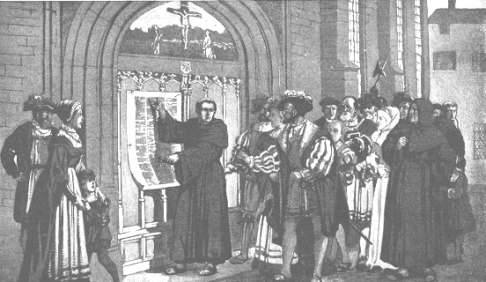
His “post” was entitled:
Disputation of Doctor Martin Luther on the Power and Efficacy of Indulgences
And it began as follows:
Out of love for the truth and the desire to bring it to light, the following propositions will be discussed at Wittenberg, under the presidency of the Reverend Father Martin Luther, Master of Arts and of Sacred Theology, and Lecturer in Ordinary on the same at that place. Wherefore he requests that those who are unable to be present and debate orally with us, may do so by letter.
Because of a technology that had been developed relatively recently, the Gutenberg printing press, Luther’s theses went “viral” and changed the course of history. They were translated from Latin into German and spread throughout Germany within two weeks, and throughout Europe within two months.
So although I have no delusions about the relative import of my thinking compared with Luther’s, tomorrow I’m going to post my own set of theses relating to social media, and will invite your feedback and participation, or even disputation.
There won’t be 95 of them (but there will be more than the five I outlined at Healthcamp MN), and I’m confident the publication of these theses won’t require me to go into hiding in a castle in Germany (although, come to think of it, that wouldn’t be the worst thing!)
Just as technology gave viral reach to timeless truths as recovered by Luther, today’s social technology will enable these social media theses to spread rapidly (if they’re any good). It’s a testament to the advance of technology that within two days of publication (based on what I see in my Google Analytics), these theses will likely have been read on six continents.
Luther’s theses had eternal significance for people’s immortal souls. Mine might just help you better understand the communications and marketing landscape, and thereby achieve some of your more temporal goals.
Luther wanted to start a discussion or an argument, even though he was fairly convinced he was right. I likewise hope to spark discussion with my social media theses, and some of that will take place starting Monday in Las Vegas at the Healthcare Internet Conference. But to paraphrase Luther’s request, if you are unable to be present and debate orally with us, I hope you will do so by Tweet, comment or blog post.
Check back here tomorrow for discussion and disputation.