Sharing Mayo Clinic

Sharing Mayo Clinic
Sharing Mayo Clinic

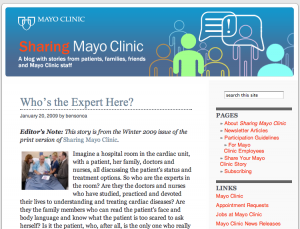
Today we take a significant step for Mayo Clinic, launching our “culture” blog for patients and staff, called Sharing Mayo Clinic. I’ll be showing it as part of my presentation at BlogWell.

Sharing Mayo Clinic (at sharing.mayoclinic.org) is in many ways the culmination of a process we’ve had in the works for the last few years, starting with our first podcasts in Sept. 2005. As you can see in the post announcing Sharing Mayo Clinic my colleague Elizabeth Rice published this morning on our Mayo Clinic News Blog, we’ve had some other significant milestones that have helped bring us to this point, such as establishing a Facebook page and a YouTube channel. (You’ll also see some video of me talking about the project.)

But in another sense, Sharing Mayo Clinic is less recent and more timeless; it’s a logical extension of what Mayo Clinic patients have been doing for more than a century. Word of mouth from patients is the number one reason people give as their source of information about Mayo Clinic. Like our Facebook page, this blog is just a new way for patients to share their stories.

Sharing Mayo Clinic also will be a way to feature the work and stories of Mayo employees in various roles throughout the organization, who all contribute to creating the Mayo Clinic experience for patients and their families.

The blog is a work in progress, and we look forward to seeing it grow into a hub for Mayo Clinic’s various social media platforms. We have some ideas for new features and functionality once we’re past the launch stage, but I’d really like to know what you think of it so far, and how you think it could be improved.

Please check it out and give me your feedback! And I’d really appreciate it if you’d take the time to pass this along to your friends using the “ShareThis” icon below.

New Mayo Clinic Blog Launches Tomorrow

In 22 hours we will be launching a major new blog for Mayo Clinic. I’ll be publishing a post about it here tomorrow (and showing it during my presentation at BlogWell in Chicago), but if you would like to preview the blog for purposes of your own blogging or tweeting (or good old-fashioned news reporting), send me a message in Facebook or a direct message in Twitter.

I’d be happy to send you a preview link and some background info, with the understanding that you wait until 7 a.m. EST tomorrow to publish anything about it. After that I would be delighted, of course, if you chose to help spread the word.

Dr. Seltman’s Opus

Among the reasons for my relatively lighter posting in the last few days is this video, which I produced (with some of my colleagues) to honor Kent Seltman, who celebrates his retirement from Mayo Clinic at a reception this afternoon.

[youtube=http://www.youtube.com/watch?v=ZjtCAmmT4h8]

Unlike the character played by Richard Dreyfuss, Kent not only left his influence within the lives of the people with whom he worked at Mayo. He actually did get to write his Magnum Opus. Kent is the author, with Leonard Berry, of Management Lessons from Mayo Clinic: Inside One of the World’s Most Admired Service Organizations. You can read a review here.

Patient Voice in Health Care

Today I’m participating in an event for patients, family members and health care professionals at Mayo Clinic in Rochester. It’s called “The Voice of the Patient in Harmony with Care: Safety Through Patient and Provider Partnerships.” My presentation, which I’m giving at 9:30 a.m. and 12:45 p.m., is entitled, “The Internet and Partnership Communication Opportunities of the Future.”

I’m embedding the slides from my presentation here, and including some key links below. I would appreciate any comments, questions or other feedback from the participants, and of course if any want to become SMUGgles, you’re completely welcome.


Here is our Mayo Clinic Podcasts blog, including the posts on POTS and Niemann-Pick Disease Type C.
Here is our Mayo Clinic page in Facebook, and the Organ Transplant group, as well as the Mayo Clinic-sponsored CarePages service.

Here is our Mayo Clinic YouTube channel, as well as one of the patient story videos from Rhonda King.

[youtube=http://www.youtube.com/watch?v=AFYiaMuZY4g]

This is the link, I believe, to the Long QT group on Yahoo that she mentioned.

Those who want to learn more about social media can enroll in SMUG, or just start with the Core Courses or the Facebook curriculum.

Please feel free to engage here in the comments, and discuss how these powerful tools could help meet important communication needs in the patient/provider relationship.

Add to FacebookAdd to DiggAdd to Del.icio.usAdd to StumbleuponAdd to RedditAdd to BlinklistAdd to Ma.gnoliaAdd to TechnoratiAdd to FurlAdd to Newsvine

Five Free Follow-Ups For Before 5 p.m.

I enjoy giving webinar presentations like this one, but I often think of slides I wish I would have added, and examples I would like to share, after I’ve submitted the presentation file to the organizers. And sometimes I forget to mention some points that I had intended.

One of the beauties of blogging is that I can share some additional notes and highlights so that people who participated in the webinar can explore on their own. It lets me make sure I covered the key points before the presentation even starts. Some of this may be review for long-time SMUGgles, but you may find portions helpful as well.

The main point about doing this before 5 p.m. is to not procrastinate. Those in the EST time zone will have a couple of hours after the webinar, while the PST gang has the whole afternoon. But since you’re reading this now, why not get started right away?

  1. Observe some examples. Check out our Mayo Clinic Podcast Blog (and particularly this post on Niemann-Pick Disease Type C), our Mayo Clinic YouTube Channel, our Facebook page and our News Blog. See this story from yesterday’s Wall Street Journal that includes a link to a Mayo Clinic Medical Edge video story, and this post from the WSJ’s Health Blog, which included one of our Flip videos from our YouTube channel. Besides providing information directly to consumers and potential patients, “new media” tools like web video and audio can help generate or enhance your traditional news coverage.
  2. Complete Podcasting 101, which is the first course in the Podcasting curriculum at SMUG. In the coming days, as you work through the 100-level courses, you will be able to create your own podcast and have it listed in iTunes for exactly $0.00. It’s all free. Like my podcast, Chancellor Conversations, this won’t have the production quality you would want for your official organization podcasts, but by working through the process step-by-step you will strip away the mystery, and no one will be able to tell you “it’s too complicated.” Then you can spend a few hundred dollars for some better recording equipment, and develop a really solid, low-cost, high-quality communication vehicle.
  3. Enroll in SMUG. The tuition is $37,700 less than Johns Hopkins. If you or your organization spend at least a few hundred dollars on a webinar, or thousands to attend a conference, to learn about social media, wouldn’t it be silly to not take the next step and get some hands-on experience, particularly when it’s free? Besides joining the SMUG Facebook group, you can friend me (be sure to mention the webinar), or follow me on Twitter. SMUG’s mission is reflected in our motto, and our goal is to help you discover what you can do at a ridiculously low cost (or perhaps even for free) and without any support from your IT department. In economic times like this, as Jacopo asked Edmond Dantes in The Count of Monte Christo, “How is that a bad plan?”
  4. Check out Slideshare.net. I thought Elizabeth Tracey’s point about connecting audio files with Powerpoint presentations was good, and Slideshare is a way you can do it today, for free. Here’s a link to one of my slidecasts from the Podcasting curriculum to demonstrate. Slideshare is like YouTube for PowerPoints; you can embed it in your own blog or site, and also can make it available in the “marketplace” for others to find and embed, increasing your reach.
  5. Complete Social Media 101, which is part of the Core Courses curriculum at SMUG and originally was my “12-Step Social Media Program for PR Professionals.” As in all similar programs, the first step is to admit that you have a problem. Social Media 101 will give you an introduction to the broad scope of social media tools that may have application in your work.

In addition to the five free things before 5 p.m., here’s a bonus you should do after 6 tonight. It’s not free, but you’ll be glad you did it:

Get a Flip video camera.

You can find them for $150 or so at Wal-Mart or Best Buy. If you’re into the delayed gratification thing and want to work through more of the SMUG curriculum, I hear you can get them even cheaper at Amazon.com. Consider it a Christmas gift to yourself. Spend another $15 or so for a tripod. You’ll want to have this for personal use; it’s the video camera you can always have with you, so you never miss those magic moments because you forgot to bring the camera bag. But then take the Flip to work and see how you can use it for business purposes.

I hope you found the presentation (and this post) helpful, and would appreciate any feedback in the comments below.