Advertising Age, Hospital Marketing and Social Media

Advertising Age has an article this week in the print edition about hospitals, advertising, marketing and social media, and relates it all to health reform. I was glad to get to talk with the writer, Rich Tomaselli, last week to discuss some of the things we’re doing at Mayo Clinic, and our philosophy relating to social media. Rich had said the article would run either this week or next, and so I was glad when Jane Sarasohn-Kahn (@healthythinker) alerted me to it with her tweet linking to her blog post about it.

I think both Rich’s article and Jane’s post are good and make some valid points, and commend them to your reading.

Here’s my Advertising Age quote, upon which I want to expand a bit:

One of the most famous health-care facilities in the country, the 118-year-old Mayo Clinic, now has a social-media manager, Lee Aase. “Social media is the way word-of-mouth happens in the 21st century,” he said. “Twitter is just one of the most powerful networking tools that I’ve ever seen. It enables you to make connections with people that have a common interest.”

Quotes in mass media (like magazines, TV or radio) are always taken out of context. That’s not a criticism, it’s just a reality. Space and time are limited and expensive. Rich and I talked for about 15 minutes, and it was a great conversation. I’m sure he likewise had good talks with the others he quoted (and he did incorporate elements of our interview in his narrative.) There’s no way all of that is going to fit in a print article.

One of the benefits of social media, however, and why these tools are so powerful, is the opportunity they afford for more in-depth content and discussions. They provide a way to get more in-depth information to (and feedback from) people who are interested.

Given the fact you’re reading this, you must be one of those interested ones, when the topic is advertising, health care or social media. So here is some of the context of my conversation with Rich, and some reaction to the messages I saw in the article.

First, I’m quoted as saying “social media is the way word-of-mouth happens in the 21st Century” which is true and accurate, but the real point, and what I emphasized in the interview, is the continuity of social media with how Mayo Clinic’s reputation has been built over the long term. For more than 100 years, the number one way people have found out about Mayo Clinic is through the recommendation of a friend or family member. It’s also consistent with Thesis 1, that social media are as old as human speech.

Mayo Clinic hasn’t advertised nationally in the traditional media outlets. As Jane says in her post:

It takes information PLUS a “life moment” PLUS a “care connection” to a friend or loved one to deeply engage in health.

Paying for advertising (information) to be sent to a broad, undifferentiated group of people who aren’t currently experiencing the “life moment” or “care connection” is an iffy proposition. You’re paying to reach a lot of people who just don’t have a current need.

As I told Rich, the fact that 25 percent of our Mayo Clinic patients come from more than 500 miles away adds another layer of difficulty to the advertising equation. People need to be much more motivated before they will travel that distance for care. By definition, those patients are “deeply engaged.” But traditional advertising in mainstream media isn’t likely to be a great way to reach them because they are widely scattered across the nation (and even the world.)

This brings me to my other major observation, that the connection of all of this increased social media activity to health reform is significantly overstated. At Mayo Clinic, we have been involved in social media since 2005, starting with podcasts. We launched our Facebook fan page in November of 2007. We have been in Twitter since early 2008. We have been actively uploading videos to our Mayo Clinic YouTube channel for more than two years as well. And our Sharing Mayo Clinic blog for stories from patients and employees is nearly 18 months old.

I believe health reform legislation is essentially a non-factor in the growth in social media adoption among hospitals. Instead, as I explain it in my 35 Social Media Theses, the reason hospitals are using social media is because this is the defining communications trend of the Third Millenium.

As my good friend Ed Bennett (@EdBennett) said in the Advertising Age article, the number of hospital Twitter accounts has more than doubled in the last year, which indicates that this isn’t mainly spurred by health reform legislation. He also offers great advice on the “why” hospitals should be involved in social media:

Hospitals realize that word-of-mouth is the most significant driver you can have, so social media is an opportunity to humanize what can be a scary, complex institution… I tell hospitals “Don’t get into social media because you think you’re going to get more patients. Do it because you’re helping be responsible to people reaching out looking for answers.”

Social media in health care is about much more than just marketing. As for the increase in advertising spending that’s being reported, maybe health reform is playing a role in that. It’s not really my area of expertise, so I don’t have a strong opinion on the matter.

What do you think? Do you agree that increased social media interest among hospitals is essentially unrelated to health reform?

What relationship, if any, do you see between health reform and the reported growth of spending on hospital advertising?


Visiting Nationals Park

When I was in Washington, D.C. last week I had a free evening that gave me a chance to go see the Nationals play a baseball game. It’s relatively unusual for me to be overnight in a city instead of traveling (I generally fly in one night and out the next), but in this case I had the extended opportunity.

Here are some photo memories from the adventure (click any of the photos to view a larger size):

The view from the back concourse (I arrived just after the game started):

I got a really good seat through an interesting exchange. As I was standing in line to buy a ticket, a guy came up to the group and said, “Anyone here alone?” I said I was, and he said, “Here, take this. It’s a really good seat…It’s about a $70 ticket.” Before I could reach for my wallet to give him a token of my thanks, he was gone.

While it would have been nice to see rookie phenom Steven Strasburg pitch, I’m pretty sure I wouldn’t have gotten a seat like this if I had been there the next night:

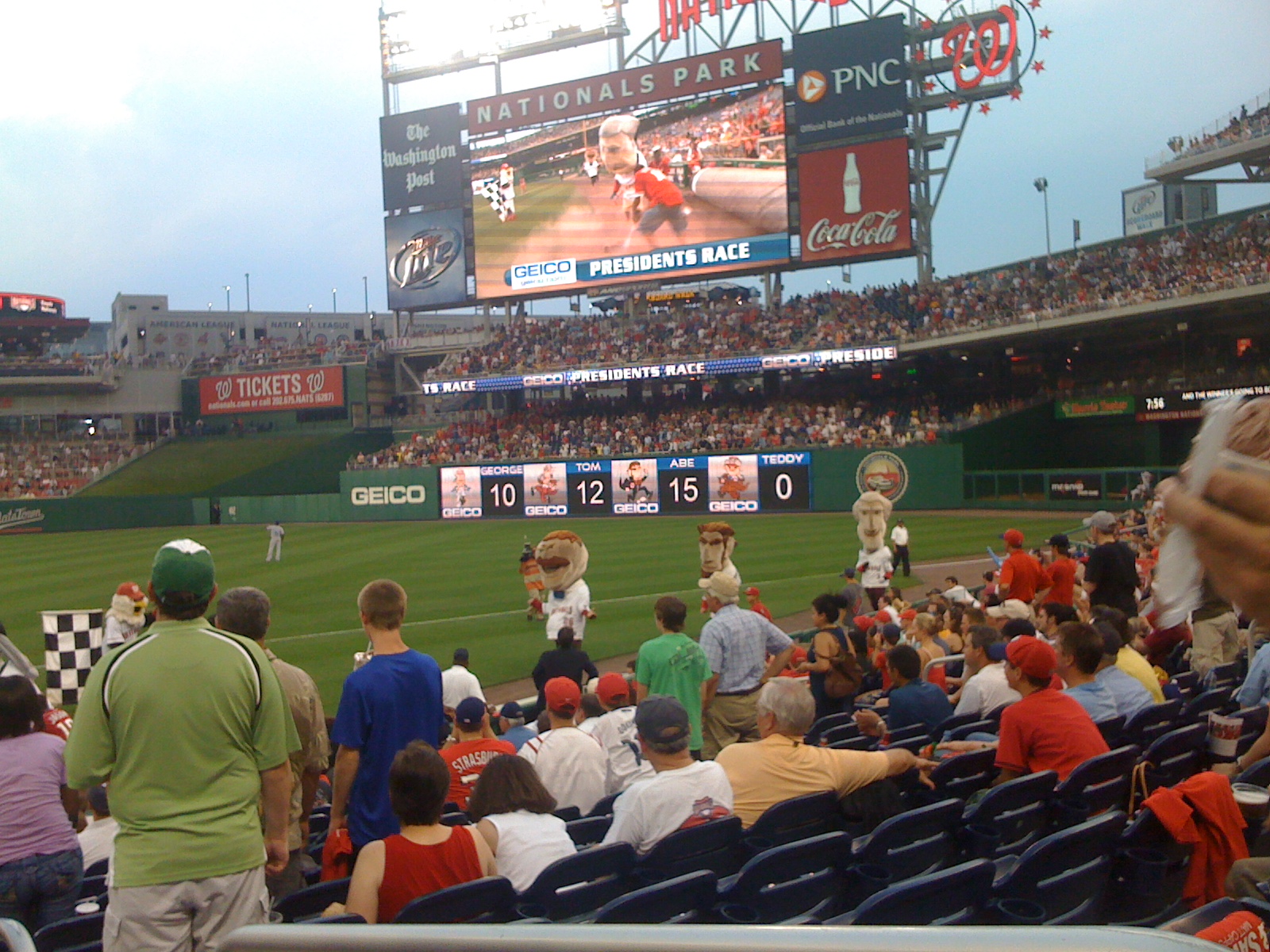
At Nationals Park the between-innings diversions have a governmental/historical feel, such as the Presidents Race:

George won this time.

It was REALLY hot that night, and was almost unpleasant even in shorts. But a nice rain shower cooled things down significantly (and also led to a rain delay):

And after the rain delay I was able to even get a slightly better seat in the 18th row:

All in all, as I left a little early to catch the Metro back to the hotel, it was a memorable night:

Off-Label Social Media Uses with Powerful Interactions

I was in Alexandria, Virginia today for a conference sponsored by the Center for Business Intelligence, at which I’m sharing our Mayo Clinic case study on social media in health care. Here are the slides I used for this shorter case study, which was tailored to the (mostly) pharmaceutical background of the audience:

One of the points I made is that these social media tools are individually powerful in their own right, but that when combined they can have amazing interactions. And I added something to my standard series of disclaimers: “Do not drive or operate heavy machinery while engaging in social media.”

I welcome your questions and comments.

Boldly going where few have gone before…

That’s part of my refreshed presentation on social media, which I’m delivering this morning for the Missouri Hospital Association.

My North Carolina and Iowa friends, to whom I presented last week, also will find this helpful for review.

Twitter 135: 10 Reasons to NOT Protect Your Tweets

Note: This is part of the Twitter curriculum on SMUG.

In the last week or so I’ve had some great interactions with Lisa Fields (@PracticalWisdom on Twitter.) She gave me the heads up about Marc Slavin, the hospital PR guy who ignored a reporter’s repeated requests to “stop touching me!” as described in my recent Manual Spam post.

In our back and forth discussion I realized that Lisa had “protected” her tweets, and I asked her why. Her response:

Protect Tweets: Open to coaching. Have gotten requests from “less than splendid” Didn’t want to be associated. Will take your advice.

So I asked Lisa for her email address to send her some reasons why she should change her tweets to “unprotected.” What you see below is what I sent her, and I’m happy to report that as of right now you can follow Lisa without having to ask permission.

I did, however, ask Lisa’s permission to share this story, as well as the reasons I had outlined for her, to help others who may have similar questions or concerns. She agreed.

Here’s what I told Lisa:

It’s understandable why you might instinctively choose to “protect” your tweets. Especially with the controversy over Facebook and its privacy settings, it may feel like protecting your tweets is safer, and would better safeguard your privacy.

That’s true, to a point. And depending on how you want to use Twitter, it COULD be a valid choice.

I think that’s highly unlikely, though, particularly in your circumstance. For almost anyone (I would say more than 95 percent of Twitter users), protecting tweets is counterproductive.

Here are 10 reasons why you should NOT protect your Tweets:

  1. Twitter isn’t Facebook. Facebook is for your friends. Twitter is for the friends you don’t know yet. Here is an example of how I got to meet someone through Twitter who has become a good friend.
  2. Following isn’t Friending. This is related to the first point. On Facebook you can require that only your friends can view your profile. People have to ask permission to see more details. That’s entirely appropriate, because you probably have personal information there, such as your birthday, phone number, family members and other details that you likely want to keep private. On Twitter, your entire bio is 160 characters. You may also have a link to your Web site or blog, but that’s the extent of the really personal information.
  3. What if everyone did it? If everyone protected their updates Twitter would be much less useful as a networking platform. You would connect with people you already know, as on Facebook, but wouldn’t meet people with common interests who are tweeting about topics of interest to you.
  4. Protecting your Tweets is a barrier to connections. Given your business, I don’t think you can afford that. Ideally, you want people to find out about you and connect with you, which will lead to more speaking engagements and training opportunities. More business. If your tweets are protected, it will keep others from finding out about you, because they won’t discover your tweets.
  5. You can block the bad actors. In one of your messages to me you said “Have gotten requests from ‘less than splendid’ Didn’t want to be associated.” If an unsavory character starts following you on Twitter, and it really creeps you out, you can block him. (Most of the creepy ones would probably be “hims,” wouldn’t they?) But they won’t be around for long anyway. Spammers get identified and blocked by others, and if enough people block them the accounts are suspended.
  6. The solution to some unwanted followers is to get a LOT of followers. As my friend Andy Sernovitz says, “The solution to pollution is dilution.” Then if you have some “less than splendid” followers it won’t be a big deal.
  7. Why would you want all the burden of networking to fall on your shoulders? Why not make it a mutual thing? If your tweets are protected the only way you’re likely to make new connections is by initiating “follows.” But by practicing unprotected tweeting you will find that people who are interested in what you are saying will want to follow you. Many of these will likely be interesting people for you to follow. You may find this post interesting, because it has some data about protected tweeters, and particularly that they have fewer followers. That makes sense, that if people have to ask permission to follow you, fewer will.
  8. The Cocktail Party Analogy – This is a metaphor many have used to describe the right way to behave in social media. If you wouldn’t do it in person at a party, don’t act that way in social networking platforms. In these illustrations, most often the undesirable example is Ed the Egomaniac. He comes in and just talks incessantly about himself. But there is another type that’s just as likely to kill the conversation. Eva the Eavesdropper. She doesn’t talk at all. She just listens in on others’ conversations without contributing (and often without their knowledge.) It’s unwelcome behavior in real life, so don’t do it in Twitter.
  9. You’re in a tiny minority. That doesn’t mean you’re wrong, of course. But the default for Twitter is to not protect, and if everyone else is interacting freely you are not going to be as fully connected, which will put you at a disadvantage.
  10. Be smart. For your own safety, you might not want to tweet a message like, “Home all alone. Locks on my front door don’t work. Sure hope that $25K in cash under mattress is safe until I can call the locksmith Monday.” But if you’re just tweeting conversationally and sharing links to interesting reading, you won’t have much cause for concern about personal safety or privacy violations.